Solar Panels for Data Centres UK
UK data centres consume over 12 TWh annually and growing at 15% per year. With electricity representing 40-60% of operating costs and increasing pressure to demonstrate sustainability, on-site solar generation delivers measurable PUE improvement, cost reduction, and verified Scope 2 emissions cuts.
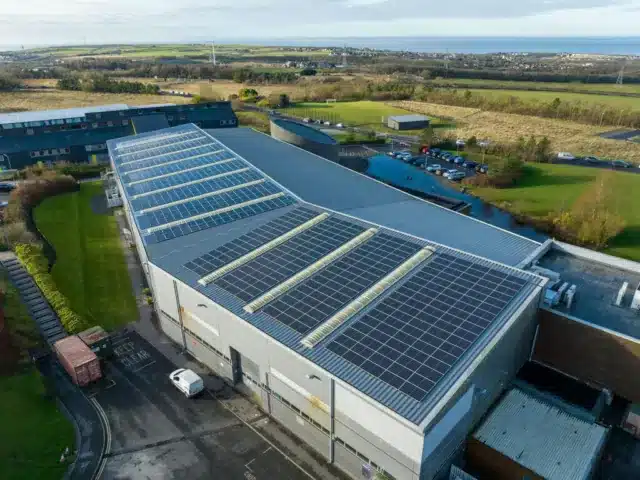
Solar for Data Centres
Data centres are the hardest commercial buildings to power from on-site solar — not because solar is unsuitable, but because the IT load is enormous relative to available roof area. A data centre runs a flat 24/7 baseload measured in megawatts, whereas a rooftop PV array is capped by the square metres of available roof. The result is a high self-consumption ratio (every kWh is used the instant it is generated) but a modest percentage offset of total facility demand. The honest planning question is therefore not "can solar power my data centre?" but "what share of my baseload can rooftop and on-site solar realistically offset, and how does that feed PUE, RE100 and Scope 2 reporting?"
The table below sizes that offset for typical UK facilities. It assumes a UK yield of ~950 kWh/kWp/year and a flat MW IT load running continuously. Because the IT load is constant while solar is intermittent, the percentage figures are annual energy offsets, not instantaneous. Larger campuses with on-site land for ground-mount arrays achieve materially higher offsets than roof-constrained colocation halls. Pairing the array with industrial battery storage shifts midday surplus into evening baseload and unlocks grid-services revenue, while a properly engineered three-phase solar integration into the MV switchgear keeps the connection within Tier III/IV redundancy rules.
| Facility type | MW IT load (24/7) | Usable roof / land | Solar capacity | Annual solar yield | % of facility demand offset |
|---|---|---|---|---|---|
| Edge / small colo | 0.5 MW (~4.4 GWh/yr) | 800–1,500 m² roof | 150–250 kWp | ~0.14–0.24 GWh | 3–5% |
| Medium colocation | 2 MW (~17.5 GWh/yr) | 3,000–6,000 m² roof | 500 kWp–1 MWp | ~0.48–0.95 GWh | 3–5% |
| Large enterprise | 5 MW (~43.8 GWh/yr) | 6,000–10,000 m² roof + apron | 1–1.5 MWp | ~0.95–1.43 GWh | 2–3% |
| Hyperscale (roof only) | 10 MW (~87.6 GWh/yr) | 8,000–15,000 m² roof | 1–2 MWp rooftop | ~0.95–1.9 GWh | 1–2% |
| Hyperscale campus + ground-mount | 50+ MW (~438 GWh/yr) | On-site land for ground array | 5–20 MWp ground + roof | ~4.75–19 GWh | 5–15% |
Annual energy offset, not instantaneous. Assumes ~950 kWh/kWp UK yield, continuous MW IT load, 95%+ self-consumption. Connections above 50 kWp require a G99 DNO application (NGED across the Midlands, South West and South Wales).
PUE, RE100 and Scope 2 — how solar reads in your reporting
PUE (Power Usage Effectiveness) is total facility energy divided by IT energy. On-site solar does not change the ratio directly — a watt of solar still serves either IT or overhead — but it cuts the grid-drawn kWh behind that ratio, which is what drives both your electricity bill and your reported carbon. The headline metric that genuinely moves is your renewable-energy share, not PUE itself; treat any "solar improves PUE" claim with care.
RE100 members (AWS, Microsoft Azure, Google Cloud, Equinix, Digital Realty among UK operators) commit to 100% renewable electricity. On-site solar is the most defensible renewable claim available — physically on the meter, additional, and free of the additionality questions that dog unbundled REGOs or grid-renewable tariffs. Every MWh generated on-roof is an MWh that needs no certificate.
Scope 2 emissions (purchased electricity) fall directly with on-site generation under both location-based and market-based accounting. For colocation providers, that same generation helps tenants evidence their own Scope 3 supply-chain emissions — increasingly a procurement-qualification requirement from financial-services, pharma and big-tech customers. The EU Energy Efficiency Directive already mandates annual PUE, water and renewable-share reporting for data centres above 500 kW, and UK regulation is expected to follow; on-site solar is one of the most visible, verifiable inputs into that disclosure.
Why Data Centres Are Investing in On-Site Solar
Beyond cost savings, data centre operators face mounting pressure from clients, investors, and regulators to demonstrate genuine sustainability progress.
The Data Centre Energy Challenge
Electricity Costs Dominate OpEx
Energy represents 40-60% of data centre operating costs. At 27.69p/kWh (2026 Ofgem non-domestic rate), a 5MW facility spends £8-12M annually on electricity alone. On-site solar provides a fixed-cost energy source immune to wholesale market volatility.
Client Sustainability Demands
Enterprise clients increasingly mandate renewable energy use in vendor selection. On-site solar provides verified, additional generation that satisfies RE100, CDP, and SBTi requirements without reliance on purchased certificates.
Grid Capacity Constraints
New UK data centres face grid connection delays of 3-7 years. On-site solar and battery storage can supplement existing grid capacity, enabling facility expansion without waiting for DNO upgrades.
Regulatory Trajectory
The EU Energy Efficiency Directive already requires data centres to report energy consumption. UK regulations are following. Proactive solar investment demonstrates compliance readiness and sustainability leadership.
Solar-Data Centre Synergies
Peak Cooling Alignment
Solar generation peaks when cooling demands are highest. Summer heat that drives up CRAC/CRAH energy consumption coincides with maximum solar output, providing natural load matching.
Constant Base Load = Maximum Self-Consumption
Data centres never stop consuming electricity. Every kWh of solar generated is consumed immediately on-site, achieving 95%+ self-consumption ratios.
Energy Price Hedging
On-site solar locks in a portion of energy costs at £0.03-0.04/kWh LCOE for 25+ years, providing a natural hedge against volatile wholesale electricity prices that have swung 200-300% in recent years.
Battery Storage for Grid Services Revenue
Co-located battery storage paired with solar enables participation in frequency response, capacity market, and demand turn-up services, generating additional revenue streams of £50-100/kW/year.
Data Centre Solar ROI Analysis
Financial modelling for UK data centre solar installations at 2026 energy prices
| Facility Type | IT Load | Solar System | Investment | Annual Saving | Payback |
|---|---|---|---|---|---|
| Edge / Small Colo | 500kW | 250kW rooftop | £162,000 | £52,000 | 3.1 years |
| Medium Colocation | 2MW | 750kW rooftop | £435,000 | £148,000 | 2.9 years |
| Large Enterprise | 5MW | 1.5MW roof + ground | £870,000 | £296,000 | 2.9 years |
| Hyperscale Campus | 20MW+ | 5MW+ ground mount | £2.5M+ | £850,000+ | 2.9 years |
Based on 27.69p/kWh Ofgem non-domestic rate (Q1 2026), 950 kWh/kWp yield, 95%+ self-consumption. Excludes additional revenue from grid services.
Zero-Downtime Installation Process
Engineered for facilities where every minute of uptime matters
Facility Assessment
Full site survey including roof structure, electrical infrastructure, grid connection capacity, and cooling system integration points. Detailed method statement provided.
Design & DNO Application
System designed around your power architecture. G99/G100 application submitted. Redundant connection pathways engineered to maintain Tier III/IV compliance.
Non-Disruptive Install
Ballasted roof mounting with no penetrations. Pre-assembled components minimise on-roof time. All hot works excluded near critical infrastructure.
Commission & Monitor
Phased commissioning with real-time monitoring integration. DCIM connectivity for power and generation tracking alongside existing infrastructure metrics.
Frequently Asked Questions
Common questions about solar for data centre facilities
How do solar panels improve data centre PUE?
Can solar panels be installed on a data centre without any downtime?
What size solar system does a typical UK data centre need?
Do data centre solar installations qualify for Annual Investment Allowance (AIA)?
How does on-site solar help meet RE100 and net zero commitments?
Get Your Matched Data Centre Solar Quotes
Request quotes from commercial solar installers who can analyse your power architecture, cooling loads and available space, and ask each how its design would affect PUE and OpEx.
Related Resources
Industrial Battery Storage Guide
Battery storage for data centres: peak shaving, UPS supplementation, and grid services revenue.
Commercial Solar Installation
Overview of commercial-scale solar for large facilities across the UK.
Factory Solar Costs 2026
Complete pricing breakdown for industrial and commercial solar installations.
Continue Reading — Related Topics
Hand-picked guides covering the most relevant adjacent areas to this page.
By Industry / Sector
Regional & Commercial Guides
Commercial solar panels for data centres — UK 2026 deployment guide
UK data centres are among the world's fastest-growing electricity consumers — collectively consuming approximately 2.5% of UK electricity demand in 2026 (around 12 TWh/year), and projected to reach 6% by 2030 driven by AI workload growth. The combination of massive 24/7 baseload, large flat or low-pitched roof areas, three-phase MV electrical infrastructure, and increasingly aggressive Power Usage Effectiveness (PUE) and Scope 2 emissions targets makes commercial solar panels for data centres a strategically important investment for UK operators.
UK solar system data centre — typical deployment profile
A typical UK data centre solar installation in 2026 is constrained by available roof area rather than electricity demand — a 5 MW data centre consumes ~44 GWh/year, while even a 2 MW solar array on the same building roof only generates ~1.9 GWh/year (4% of demand). Solar therefore typically forms part of a broader renewable energy strategy rather than the sole source. Typical installation profile:
| Facility size | Roof area | Typical solar system | % of facility demand offset |
|---|---|---|---|
| 500 kW edge DC | 800–1,500 sqm | 150–250 kW | 5–7% |
| 2 MW colocation | 3,000–6,000 sqm | 500 kW–1 MW | 2–4% |
| 10 MW hyperscale | 8,000–15,000 sqm | 1–2 MW rooftop | 1–2% |
| 50+ MW hyperscale campus | on-site land for ground-mount | 5–20 MW ground + rooftop | 5–15% (annual) |
Solar for data centres — RE100 & Scope 2 reporting
Most UK hyperscale data centre operators (AWS, Microsoft Azure, Google Cloud, Equinix, Digital Realty, CyrusOne) have committed to RE100 — sourcing 100% of their electricity from renewable sources. On-site solar PV is one of the most credible forms of renewable claim (it's physical, on-site, contractually clean) compared to grid-renewable tariffs or unbundled REGOs. For colocation providers, on-site solar also helps tenant customers meet their own Scope 3 emissions disclosure obligations — increasingly a procurement-qualification requirement from financial-services, pharma and big-tech tenants.
The EU's Energy Efficiency Directive (recast 2023) now requires EU data centres above 500 kW to report PUE, water use and renewable energy share annually — a model the UK is expected to mirror in upcoming regulation. On-site solar is one of the most visible and verifiable inputs into that disclosure.
Solar panel for a data centre — UK locations & specifics
UK data centre clusters and their solar deployment context:
- West London (Slough Trading Estate, Iron Mountain Slough, Equinix LD8, Microsoft) — hyperscale and colocation cluster; UKPN constrained; many sites use 500 kW–2 MW rooftop solar plus corporate PPA
- Greater London (Docklands E14, Stratford E15, Barking IG11) — colocation and enterprise DCs; mix of rooftop and PPA
- Manchester (MediaCity, Trafford Park, Salford Quays) — colocation cluster (Equinix MA1, Telehouse Manchester) — ENWL G99 the project constraint
- Edinburgh / Newbridge — Microsoft Azure region; SP Energy Networks DNO; strong G99 environment for new solar
- Wales (Newport, Cardiff) — emerging cluster, ample grid capacity, growing solar opportunity
- Cambridgeshire / Hertfordshire (St Albans, Cambridge area) — enterprise and colocation DCs; UKPN East constrained