Commercial Solar Panels
Derby & the East Midlands
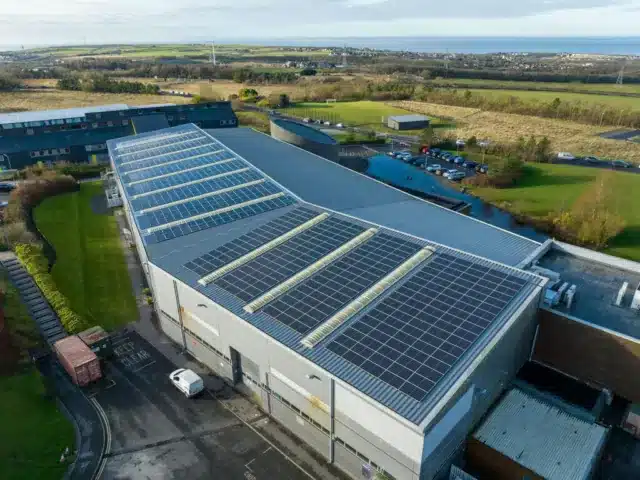
Commercial solar panel installation across Derby, Derbyshire and the East Midlands — factories, warehouses and advanced-manufacturing units serving Rolls-Royce and Toyota suppliers. NGED G99 grid connections handled end to end.
Derby Factory Solar FAQs
Common questions about solar installation in Derby & East Midlands
How much does factory solar installation cost in Derby?
Derby factory solar installations typically cost £710-£970 per kW installed. With 100% Annual Investment Allowance (AIA) tax relief, most East Midlands factories see payback periods of 3.0-4.0 years.
What areas in Derby and East Midlands do you cover?
We cover all Derby and East Midlands industrial areas including business parks, industrial estates, and manufacturing zones. Our regional team has excellent access to all major road networks.
Is Derby suitable for solar power generation?
Yes, Derby receives approximately 955 kWh/m2 of solar irradiance annually - sufficient for excellent returns. Modern panels work efficiently year-round in UK conditions.
What industries do you serve in Derby?
We serve Derby's diverse manufacturing base including Aerospace (Rolls-Royce), Rail (Alstom/Hitachi), Toyota Supply Chain. Our team understands the specific requirements of each sector and tailors installations accordingly.
What grants are available for Derby manufacturers?
Derby manufacturers can claim 100% Annual Investment Allowance (AIA) on the first £1m of qualifying spend, then the permanent 50% first-year allowance above that. There is no broad commercial cash grant in England — the tax relief and export income are what actually cut the net cost.
Get Your Derby Factory Solar Quote
Free site survey and quote for your Derby or Derbyshire manufacturing facility.
Industrial Solar Services in Derby & Derbyshire
Comprehensive solar panel solutions for Derby & Derbyshire manufacturing facilities, warehouses, and industrial operations.
Warehouse Solar Panels
Large-scale solar installations for distribution centres and logistics facilities in Derby & Derbyshire.
Distribution Centre Solar
Specialized solar solutions for Derby & Derbyshire distribution and fulfillment operations.
Food Manufacturing Solar
HACCP-compliant solar installations for Derby & Derbyshire food processing facilities.
Automotive Manufacturing Solar
Solar solutions for Derby & Derbyshire automotive plants and component manufacturers.
Pharmaceutical Solar
GMP-compliant solar systems for Derby & Derbyshire pharmaceutical facilities.
Chemical Manufacturing Solar
COMAH and ATEX-compliant installations for Derby & Derbyshire chemical plants.
Electronics Manufacturing Solar
Cleanroom-compatible solar for Derby & Derbyshire electronics facilities.
Metal Fabrication Solar
High-power solar systems for Derby & Derbyshire metal fabrication shops.
Textile Manufacturing Solar
Energy-efficient solar for Derby & Derbyshire textile and garment facilities.
Plastics Manufacturing Solar
Solar solutions for Derby & Derbyshire plastics processing and injection molding.
Factory Solar Panels
General manufacturing solar installations for Derby & Derbyshire factories.
Grid Connection & DNO — Derby
Related Guides for Derby Manufacturers
Most Derby manufacturers start by shortlisting solar panels for business and benchmarking commercial solar panel cost; we handle the comparison for you, free and supplier-neutral.
Solar ROI Benchmarks for Derby Manufacturers
Derby's aerospace (Rolls-Royce), rail (Alstom) and advanced manufacturing clusters run highly energy-intensive operations at Pride Park and Sinfin; Electricity East Midlands provides DNO infrastructure for G99 solar applications.
| System Size | Installed Cost | Annual Saving | Payback Period | CO2 Saved/yr |
|---|---|---|---|---|
| 100 kWp | £72,036 | £19,601/yr | 3.7 years | 23 tonnes |
| 350 kWp | £196,100 | £68,605/yr | 2.9 years | 80 tonnes |
| 1 MW | £470,239 | £196,015/yr | 2.4 years | 230 tonnes |
Nearby Service Areas
We also serve industrial facilities in these nearby locations
Derby: East Midlands Gateway Logistics Solar
Derby occupies a strategic position at the northern apex of the East Midlands logistics cluster, adjacent to SEGRO's East Midlands Gateway at Castle Donington — one of the UK's largest inland freight interchanges, directly connected to East Midlands Airport. The A38, A52 and M1 corridor supports major logistics and manufacturing operations, from Rolls-Royce's supply chain partners to Amazon and DHL regional distribution hubs. For industrial operators, Derby's position means shorter vehicle movements and lower operational costs — factors that increasingly drive solar investment decisions.
Derby manufacturers and logistics operators benefit from above-average roof space utilisation: many sites were built in the 1980s–2000s with shallow-pitch industrial roofs ideal for solar arrays. A 500kW installation on a 120,000 sqft facility can generate over 475 MWh annually at Derby's irradiance levels, with savings of approximately £119,000 per year at current electricity prices. For supply chain companies in leased premises, a Solar PPA allows immediate savings with zero capital spend.
Derby Industrial Solar Benchmarks
| 120,000 sqft facility | 450–600kW system |
| Annual generation | 427–570 MWh |
| Annual saving | £107k–£143k |
| Typical payback | 3.0–3.8 years |
Key Derby Logistics Estates
- ✓East Midlands Gateway (SEGRO) — Castle Donington
- ✓Raynesway Industrial Estate — A52 corridor
- ✓Sinfin Commercial Park — south Derby
- ✓Toyota & Rolls-Royce supply chain cluster
See our full guide: Solar Panels for UK Logistics & Warehouses — Golden Triangle Guide
Helpful Resources for Derby Manufacturers
Expert guides and tools to help you make informed decisions
Getting Started
Technical Information
Derby industrial solar — the local picture
Derby is part of East Midlands, with population 261,400. Average commercial electricity spend per SME in Derby: ~£44,000/year.
Derby City Council has a net zero target of 2035. Local framework: Derby Climate Change Strategy.
Major Rolls-Royce Aerospace presence drives advanced-manufacturing decarbonisation focus. East Midlands Freeport (partial) status applicable.
For UK industrial electricity at 27.69 p/kWh (Q1 2026 Ofgem), a Derby factory drawing 800 MWh/year is paying ~£220,000/year for grid power. A 250 kW rooftop solar PV system on a typical factory roof will offset 35–55% of that, saving ~£58,000 in year 1 with full Annual Investment Allowance tax relief in year 1.
Industrial estates we serve in Derby
All major industrial estates, business parks and trading estates across Derby and East Midlands.
Pride Park
Active industrial / commercial estate in Derby.
Sinfin Lane
Active industrial / commercial estate in Derby.
Raynesway
Active industrial / commercial estate in Derby.
Wyvern Way
Active industrial / commercial estate in Derby.
Spondon
Active industrial / commercial estate in Derby.
Derby factory solar by industry
Whatever sector your Derby factory operates in, we have a sector-specific design.
Derby factory solar — expanded FAQ
How long does a Derby factory solar install take?
From contract signature to commissioned system: 8–14 weeks for systems up to 500 kW, 12–16 weeks for 1 MW+. The longest item is the G99 grid connection (6–18 months DNO timeline) which we initiate before contract. Physical install on roof: 2–5 days for 100–500 kW, 5–10 days for 1 MW+. We schedule installation around your shutdown windows.
What grants are available for Derby manufacturers?
Nationally: Industrial Energy Transformation Fund (IETF) Phase 3 covers 30–50% of qualifying decarbonisation costs. Annual Investment Allowance (AIA) covers 100% of capex up to £1m in year 1. Locally, check current East Midlands business support programmes — we map every available route as part of the free feasibility study.
Will I need planning permission in Derby?
In most cases no — Permitted Development Rights (Class A Part 14, GPDO 2015) cover rooftop PV on industrial buildings under 1 MW. Listed buildings, conservation areas and PV projecting more than 200mm above the roof require full planning. We confirm planning status during the desk feasibility before any quote.
What roof types do you cover in Derby?
All commercial roof types: standing seam metal (clamp-fix, no penetrations), profiled / corrugated metal (rail-mount), flat membrane (ballasted), single-ply EPDM (mechanically fixed). Asbestos-cement roofs cannot be retrofitted — refurbishment to a modern membrane is required first. See our roof weight load guide for structural requirements per roof type.
How do I get a fixed-price quote for my Derby site?
Three steps. (1) Submit a free quote request with your annual electricity spend and roof type. (2) We pull half-hourly meter data and run PVSyst yield modelling. (3) On-site survey and fixed-price proposal within 7–10 working days. No obligation, no hard-sell — we’ll tell you honestly if your site doesn’t suit solar.
Nearby cities we cover
Commercial solar Derby — East Midlands industrial market
Commercial solar Derby sits at the heart of one of the UK's most active industrial solar markets. The Derbyshire and wider East Midlands manufacturing belt — Derby, Nottingham, Leicester, Burton-upon-Trent, Loughborough — has high commercial solar deployment potential, driven by major OEM operators (Rolls-Royce, Toyota, JCB, Bombardier) and their Tier-1 supply chains all under Scope 3 mandate pressure. Derby itself hosts Rolls-Royce aerospace, Toyota Burnaston, Bombardier Litchurch Lane and a deep aerospace, automotive and rail engineering supply chain — collectively one of the highest-load commercial electricity demand profiles in the UK.
Commercial solar for facilities managers Derbyshire — typical install profile
Derbyshire commercial solar installations typically run 100 kW to 1 MW per site. The most common deployment is a 250 kW rooftop solar array on a factory or distribution centre, costing £185,000–£220,000 installed and saving £56,000–£72,000 per year at current East Midlands industrial electricity rates of 28–32p/kWh. Payback is 3.5–4 years on capital purchase, 2.5–3 years after AIA tax relief.
Derbyshire facilities managers procuring commercial solar should expect their installer to provide: PVSyst yield model from the half-hourly meter data, BS 6399 structural roof assessment, NGED G99 grid connection application (typical 6–10 weeks), MCS commissioning pack, and IWA-backed 10-year workmanship warranty. The installation itself typically completes in 3–5 days for a 250 kW system during weekends or planned shutdowns — zero production disruption.
Commercial solar installation East Midlands — DNO context
Derbyshire and the East Midlands are within the National Grid Electricity Distribution (NGED, formerly Western Power Distribution) area. NGED's East Midlands network has moderate grid headroom for new commercial solar export — typical G99 connection timelines: 6–10 weeks for systems up to 250 kW, 10–14 weeks for 500 kW+. Specific local network constraints around the Loughborough and Burton primary substations may extend timelines for new export above 500 kW — a NGED Statement of Works study (£1,500, 8 weeks) clarifies before committing.
For the full regional picture — costs by system size, the named estates we cover and NGED timelines across Derby, Nottingham, Leicester and the logistics corridor — see our commercial solar East Midlands hub.
Commercial solar Derby — sector deployment
- Aerospace (Rolls-Royce Derby, Toyota Burnaston Tier-1 chain) — Scope 3 OEM mandate; typical 500 kW–2 MW per facility
- Rail (Bombardier Litchurch Lane, Hitachi Newton Aycliffe supply) — long-life buildings, strong solar fit
- Brewing & food (Burton-upon-Trent breweries, Mars Confectionery Slough, Walkers Crisps Leicester) — high process loads; 90%+ self-consumption
- Quarrying & minerals (Peak District periphery operators) — high daytime crushing/screening loads
- Logistics & distribution (DIRFT Daventry, East Midlands Airport, Magna Park Lutterworth) — major UK distribution hub; massive flat-roof opportunity
Solar panels in Derby and Derbyshire: commercial installation for the county
Most enquiries for solar panels in Derby come from the city's manufacturing belt — Pride Park, Sinfin and Raynesway are covered above — but Derbyshire is a big county and many of the roofs we survey sit well outside the ring road. If you are searching for solar panels in Derbyshire rather than Derby specifically, the same commercial installation service applies across the county: Chesterfield and the north-east engineering towns, Ilkeston and Long Eaton in Erewash, Swadlincote and the South Derbyshire A50 corridor, Ashbourne and Matlock in the Derbyshire Dales, and Buxton and the High Peak. A Chesterfield or Swadlincote factory is quoted on exactly the same basis as one in Derby.
Derbyshire's commercial roof stock
Beyond the city, the county's most solar-ready buildings are its newer big-box and industrial estates. Markham Vale, beside the M1 near Chesterfield, and Dove Valley Park, off the A50 in South Derbyshire, are typical: modern steel-frame units with shallow-pitch profiled-metal or flat membrane roofs, large uninterrupted roof planes and three-phase supplies already sized for industrial loads. These are the easiest sites for solar PV for factories in the East Midlands — light structural work, clamp or rail mounting, switchrooms already in place. Older engineering premises in Chesterfield, Ilkeston and Belper need a structural check first, and some still carry asbestos-cement sheeting that must come off before panels go on. Neither is a barrier; both change the sequence and the price.
NGED, G99 and county timelines
Derby and most of the county sit within National Grid Electricity Distribution's East Midlands licence area, so the grid process does not change as you move around the county. Any system that will export more than 50 kW goes through NGED's G99 application, and we submit that before you sign a contract, not after. Headroom does vary by primary substation — some rural Dales circuits are thinner than the Derby–Nottingham corridor, and the High Peak around Buxton and Glossop is Electricity North West's area rather than NGED's — so we ask for the site's MPAN and half-hourly data at feasibility stage rather than assuming. Where the answer is tight, an export limitation scheme usually keeps the project moving without waiting for reinforcement.
Peak District boundary: a planning note
The Peak District National Park covers a large part of north-west Derbyshire, and its boundary matters for planning. Outside the park — which includes most industrial land around the High Peak towns of Buxton, Glossop and New Mills — permitted development rights for rooftop PV on commercial buildings usually still apply, subject to the normal height and roof-edge conditions. Inside the park boundary, additional restrictions apply and the sensible route is a pre-application conversation with the Peak District National Park Authority before any equipment is ordered. We check the boundary and planning position on every Derbyshire site during the desk study, so you know which side of the line you are on before a survey is booked. If you are weighing up commercial solar in Derby against a site over the county line, our commercial solar Nottingham page covers Nottinghamshire, and a free quote request works for any Derbyshire postcode.
Do you install commercial solar panels across Derbyshire, or just in Derby?
Across the whole county. Chesterfield, Ilkeston, Long Eaton, Swadlincote, Ashbourne, Matlock, Belper and Buxton are all routinely surveyed from Derby, and the pricing basis — typically £700–£1,050 per kWp installed depending on system size and roof type, plus 20% VAT for commercial premises — is the same wherever in Derbyshire the roof is. Only roof condition and grid headroom move the number.
Does a factory near the Peak District need planning permission for solar panels?
Usually not if it sits outside the National Park boundary — permitted development for rooftop PV on commercial buildings normally applies, provided the panels stay within the height and roof-edge conditions. If the building is inside the park, or is listed or in a conservation area, additional restrictions apply and we recommend early contact with the Peak District National Park Authority. We confirm the planning position for every Derbyshire site before quoting.