Commercial Solar Panels
Cardiff & South East Wales
Commercial solar and PV installers for Cardiff and South East Wales — factories, warehouses and industrial units from Newport and Cardiff to Bridgend and the valleys. Steel and automotive specialists, NGED G99 grid connections and Welsh Government grants handled.
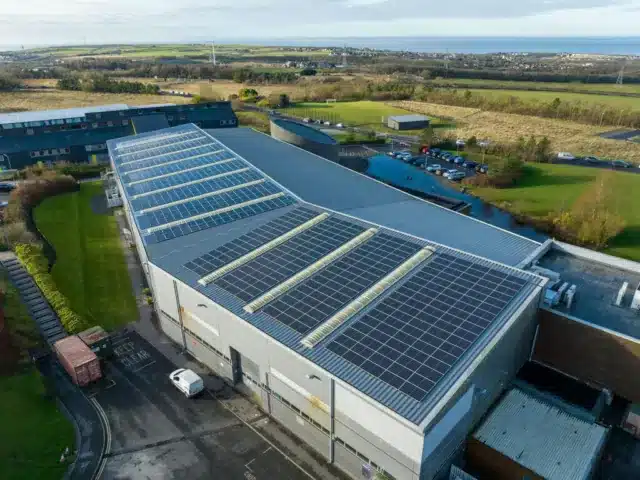
Cardiff Factory Solar FAQs
Common questions about solar installation in Cardiff & Wales
How much does factory solar installation cost in Cardiff?
Cardiff factory solar installations typically cost £720-£980 per kW installed. With Business Wales grants and Development Bank of Wales support, most Welsh factories see payback periods of 3-4 years.
What Welsh grants are available for solar?
Welsh manufacturers can access Business Wales grants, Development Bank of Wales green business loans, and enhanced support through Welsh Government initiatives. Combined support can significantly reduce installation costs.
What areas in South Wales do you cover?
We cover all of South Wales including Cardiff (CF postcodes), Newport (NP), Swansea (SA), and the Valleys. Our Welsh team has excellent access via the M4 corridor.
Is Cardiff's climate good for solar?
Yes, Cardiff and South Wales receive approximately 1010 kWh/m2 annually - comparable to Bristol and the South West. The region has excellent solar potential.
Do you work with the automotive sector in Wales?
Yes, Wales has a strong automotive components sector. We have experience with suppliers serving major manufacturers and understand the sustainability requirements of the automotive supply chain.
Get Your Cardiff Factory Solar Quote
Free site survey and quote for your Cardiff or South Wales manufacturing facility.
Industrial Solar Services in Cardiff & South Wales
Comprehensive solar panel solutions for Cardiff & South Wales manufacturing facilities, warehouses, and industrial operations.
Warehouse Solar Panels
Large-scale solar installations for distribution centres and logistics facilities in Cardiff & South Wales.
Distribution Centre Solar
Specialized solar solutions for Cardiff & South Wales distribution and fulfillment operations.
Food Manufacturing Solar
HACCP-compliant solar installations for Cardiff & South Wales food processing facilities.
Automotive Manufacturing Solar
Solar solutions for Cardiff & South Wales automotive plants and component manufacturers.
Pharmaceutical Solar
GMP-compliant solar systems for Cardiff & South Wales pharmaceutical facilities.
Chemical Manufacturing Solar
COMAH and ATEX-compliant installations for Cardiff & South Wales chemical plants.
Electronics Manufacturing Solar
Cleanroom-compatible solar for Cardiff & South Wales electronics facilities.
Metal Fabrication Solar
High-power solar systems for Cardiff & South Wales metal fabrication shops.
Textile Manufacturing Solar
Energy-efficient solar for Cardiff & South Wales textile and garment facilities.
Plastics Manufacturing Solar
Solar solutions for Cardiff & South Wales plastics processing and injection molding.
Factory Solar Panels
General manufacturing solar installations for Cardiff & South Wales factories.
Grid Connection & DNO — Cardiff
Related Guides for Cardiff Manufacturers
Most Cardiff manufacturers start by shortlisting solar panels for business and benchmarking commercial solar panel cost; we handle the comparison for you, free and supplier-neutral.
Solar ROI Benchmarks for Cardiff Manufacturers
Cardiff is Wales's primary manufacturing and logistics hub; the Capital Business Park and Imperial Park host energy-intensive operations served by SP Manweb with some of Wales's best solar resource.
| System Size | Installed Cost | Annual Saving | Payback Period | CO2 Saved/yr |
|---|---|---|---|---|
| 100 kWp | £72,220 | £20,099/yr | 3.6 years | 24 tonnes |
| 350 kWp | £196,599 | £70,346/yr | 2.8 years | 82 tonnes |
| 1 MW | £471,438 | £200,990/yr | 2.3 years | 235 tonnes |
Nearby Service Areas
We also serve industrial facilities in these nearby locations
Helpful Resources for Cardiff Manufacturers
Expert guides and tools to help you make informed decisions
Getting Started
Technical Information
Cardiff industrial solar — the local picture
Cardiff is part of Wales, with population 372,089. Average commercial electricity spend per SME in Cardiff: ~£38,000/year.
Cardiff Council has a net zero target of 2030. Local framework: Cardiff One Planet Strategy.
Welsh Government Net Zero by 2030 for public sector creates strong demand. Welsh Business Wales scheme provides SME grants.
For UK industrial electricity at 27.69 p/kWh (Q1 2026 Ofgem), a Cardiff factory drawing 800 MWh/year is paying ~£220,000/year for grid power. A 250 kW rooftop solar PV system on a typical factory roof will offset 35–55% of that, saving ~£58,000 in year 1 with full Annual Investment Allowance tax relief in year 1.
Industrial estates we serve in Cardiff
All major industrial estates, business parks and trading estates across Cardiff and Wales.
Cardiff Bay Business Park
Active industrial / commercial estate in Cardiff.
Wentloog Industrial Estate
Active industrial / commercial estate in Cardiff.
Capital Business Park
Active industrial / commercial estate in Cardiff.
Hadfield Road
Active industrial / commercial estate in Cardiff.
Pengam Green
Active industrial / commercial estate in Cardiff.
Cardiff factory solar by industry
Whatever sector your Cardiff factory operates in, we have a sector-specific design.
Cardiff factory solar — expanded FAQ
How long does a Cardiff factory solar install take?
From contract signature to commissioned system: 8–14 weeks for systems up to 500 kW, 12–16 weeks for 1 MW+. The longest item is the G99 grid connection (6–18 months DNO timeline) which we initiate before contract. Physical install on roof: 2–5 days for 100–500 kW, 5–10 days for 1 MW+. We schedule installation around your shutdown windows.
What grants are available for Cardiff manufacturers?
Nationally: Industrial Energy Transformation Fund (IETF) Phase 3 covers 30–50% of qualifying decarbonisation costs. Annual Investment Allowance (AIA) covers 100% of capex up to £1m in year 1. Locally, check current Wales business support programmes — we map every available route as part of the free feasibility study.
Will I need planning permission in Cardiff?
In most cases no — Permitted Development Rights (Class A Part 14, GPDO 2015) cover rooftop PV on industrial buildings under 1 MW. Listed buildings, conservation areas and PV projecting more than 200mm above the roof require full planning. We confirm planning status during the desk feasibility before any quote.
What roof types do you cover in Cardiff?
All commercial roof types: standing seam metal (clamp-fix, no penetrations), profiled / corrugated metal (rail-mount), flat membrane (ballasted), single-ply EPDM (mechanically fixed). Asbestos-cement roofs cannot be retrofitted — refurbishment to a modern membrane is required first. See our roof weight load guide for structural requirements per roof type.
How do I get a fixed-price quote for my Cardiff site?
Three steps. (1) Submit a free quote request with your annual electricity spend and roof type. (2) We pull half-hourly meter data and run PVSyst yield modelling. (3) On-site survey and fixed-price proposal within 7–10 working days. No obligation, no hard-sell — we’ll tell you honestly if your site doesn’t suit solar.
Nearby cities we cover
Commercial PV installers Cardiff & South Wales — M4 corridor solar market
Cardiff and the South Wales M4 corridor have emerged as one of the UK's most active regional commercial solar markets in 2026. Commercial PV installers Cardiff typically deliver 100 kW to 1 MW rooftop installations across the manufacturing, logistics and food sectors clustered between Cardiff, Newport, Bridgend, Port Talbot and Swansea. Welsh Government net-zero policy, supportive Cardiff Capital Region City Deal funding, and the high industrial electricity prices Welsh manufacturers pay (28–32p/kWh) combine to make commercial solar deployment particularly compelling in the region.
Cardiff solar panels — typical commercial installation profile
A typical Cardiff commercial solar installation in 2026 is 100–500 kW, installed at £700–£900 per kWp and generating 950–1,000 kWh per kWp annually. South Wales sits at 51.5°N latitude — one of the better-performing UK regions for solar yield. A 250 kW Cardiff installation typically generates 240,000 kWh annually, saves £60,000–£72,000 per year and pays back in 3.3–3.8 years on capital purchase, dropping to 2.5–3 years after Annual Investment Allowance tax relief.
Commercial PV installers South East Wales / South Wales / South West Wales
South Wales DNO connection (National Grid Electricity Distribution — formerly Western Power Distribution) typically processes commercial solar G99 applications in 6–10 weeks for systems up to 250 kW, 10–14 weeks for 500 kW+. Regional sub-clusters and their solar deployment context:
- South East Wales (Cardiff, Newport, Caerphilly, Monmouthshire) — densest commercial solar opportunity; M4 corridor distribution + Cardiff financial district + Newport industrial
- South Wales central (Bridgend, Port Talbot, Neath, Swansea) — steel-cluster + automotive supply chain; large industrial roofs; G99 environment more constrained around steelworks
- South West Wales (Pembrokeshire, Carmarthenshire, Llanelli, Pembroke Dock) — agricultural & food processing; ample grid headroom for larger ground-mount installations
- Vale of Glamorgan — mixed industrial & agricultural; some Glamorgan Heritage Coast planning considerations
Cardiff & South Wales solar — sector use cases
- Steel & metals transition (Port Talbot, Tata Steel UK) — electric arc furnace transition creates significant solar opportunity from 2026
- Automotive (Bridgend, Llanelli, Aston Martin St Athan) — Tier-1 OEM Scope 3 mandate; typical 250 kW–1 MW per facility
- Food & drink (Princes Foods Cardiff, Carmarthenshire dairy cluster) — high daytime loads, 90%+ self-consumption
- Logistics & distribution (Magor freight terminal, Imperial Park Newport, Cardiff Bay) — big-box flat roofs, growing EV fleet load
- Public sector (Welsh NHS, Welsh Government estate, Cardiff University, Swansea University) — Welsh Government Public Sector Net Zero by 2030 target
Solar panels in Cardiff: commercial installers for the city and Vale of Glamorgan
Cardiff's commercial roof stock is more varied than most UK cities of its size, and it shapes what a sensible solar design looks like. The Capital Quarter and city-centre office core carry flat membrane roofs suited to ballasted arrays; Cardiff Bay and Atlantic Wharf mix offices, leisure and light-industrial units where roof access and mounting details vary building by building; the big steel portal-frame sheds sit east of the city on the Wentloog and St Mellons industrial estates, where 100–1,000 kWp rooftop systems are routine; and Culverhouse Cross on the western edge concentrates large-footprint retail with strong daytime loads that suit self-consumption. If you are comparing solar panels in Cardiff for any of these building types, the starting point is the roof you actually own — not a generic price per panel.
Grid connection for commercial solar panels in Cardiff sits with National Grid Electricity Distribution (NGED, formerly Western Power Distribution), the DNO for the South Wales licence area. Any system exporting more than 50 kW needs a G99 application before energisation, and connection headroom differs street by street across the city — Wentloog's larger supplies generally take bigger systems than tighter city-centre connections. A competent commercial installer submits the G99 early, designs to the confirmed export limit, and prices any export limitation honestly rather than discovering it after the panels are on the roof.
Coverage does not stop at the city boundary. Searches for commercial PV installers in the Vale of Glamorgan come from a genuinely mixed patch — Barry Docks and its industrial units, the Llandow trading estate, agricultural and food businesses around Cowbridge, and the enterprise zone at St Athan near Cardiff Airport. Following the M4 west between junctions 33 and 37 picks up Bridgend Industrial Estate, Pyle and the coast at Porthcawl, so businesses looking for commercial PV installers around Porthcawl or Bridgend are served from the same corridor as Cardiff itself, on the same NGED network rules. The wider region is covered in our guide to commercial solar installers across South Wales.
One honest note on the Welsh market: there is no standing Welsh Government cash grant for commercial rooftop solar, and any installer promising one deserves scepticism. What Wales does offer is legitimate signposting — Business Wales provides free advice and resource-efficiency support that can help you build the business case — alongside the UK-wide capital allowances every Welsh company can claim. If you want like-for-like figures for your own building, request a free quote and we will run the numbers against your roof, load profile and NGED connection.
Who installs commercial solar panels in Cardiff?
Commercial solar panels in Cardiff are installed by MCS-certified commercial PV contractors rather than domestic fitters. We arrange design, structural checks, NGED G99 grid applications and installation for factories, warehouses, offices and retail units across Cardiff, the Vale of Glamorgan and the wider South Wales M4 corridor — free and supplier-neutral.
Do you cover the Vale of Glamorgan and Porthcawl?
Yes. We cover the whole Vale of Glamorgan — Barry, Penarth, Cowbridge, Llandow and the St Athan enterprise zone — and follow the M4 west through junctions 33–37 to take in Bridgend, Pyle and Porthcawl. The area sits in the same NGED South Wales network as Cardiff, so G99 timelines and export rules are consistent across the patch.