Carbon Neutral Manufacturing with Solar Panels UK: Complete ESG Compliance Guide
Key Takeaway: Solar installations deliver immediate, verifiable carbon reduction for UK manufacturers. A 300kW system prevents 80-100 tonnes CO2 annually, supporting Science Based Targets, SECR compliance, and supply chain ESG requirements from major automotive and aerospace buyers.
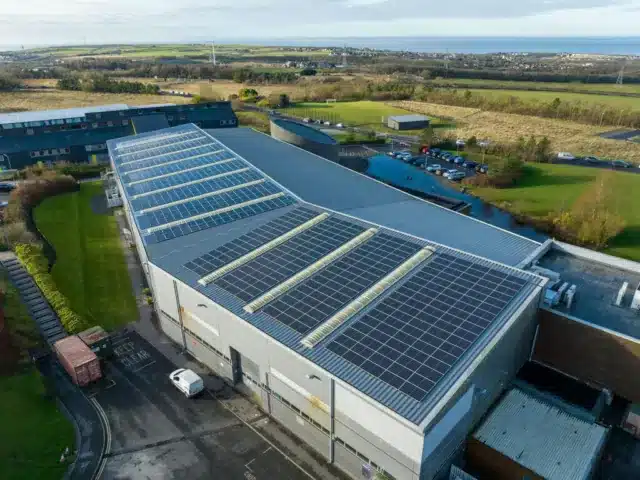
UK Manufacturing Carbon Challenge
UK manufacturers face mounting pressure to decarbonize from multiple directions: government Net Zero targets by 2050, SECR mandatory reporting, supply chain requirements, and investor ESG scrutiny. Manufacturing generates 16% of UK carbon emissions, making industrial decarbonization critical for national climate goals.
Solar panels provide the fastest, most cost-effective route to carbon reduction for factories. Unlike other decarbonization measures requiring process changes or production disruption, solar delivers immediate emission cuts while reducing energy costs.
Carbon Reduction Through Solar
Emissions Prevented Per System Size
| System Size | Annual Generation | CO2 Prevented | Equivalent |
|---|---|---|---|
| 100 kW | 95,000 kWh | 27 tonnes | 13 cars removed |
| 250 kW | 240,000 kWh | 68 tonnes | 34 cars removed |
| 500 kW | 475,000 kWh | 135 tonnes | 68 cars removed |
| 1 MW | 950,000 kWh | 270 tonnes | 135 cars removed |
Based on UK grid carbon intensity 0.283 kg CO2e/kWh (2024 average)
ESG & Compliance Drivers
SECR Mandatory Reporting
Streamlined Energy and Carbon Reporting requires UK companies with 40,000+ kWh annual energy consumption to report emissions. Solar installations provide:
- Immediate emission reductions to report year-on-year
- Demonstrable action on energy efficiency obligations
- Quantifiable carbon intensity improvements per unit produced
- Compliance with director sign-off requirements
Science Based Targets Initiative (SBTi)
Many UK manufacturers commit to SBTi-validated emission reduction targets aligned with Paris Agreement goals. Solar directly supports:
- Scope 2 Reductions: Purchased electricity emissions reduced by self-generation
- Target Achievement: Typical 300kW system delivers 5-15% Scope 2 reduction
- Verification: Generation metering provides auditable emission reduction data
- Long-term Trajectory: 25-year solar lifecycle supports 2030+ targets
Supply Chain Requirements
Major manufacturers increasingly mandate supplier carbon reduction:
Automotive Sector:
- • JLR requires all suppliers to set Net Zero targets
- • Nissan Intelligent Factory Initiative demands emission transparency
- • BMW, VW, Mercedes track Scope 3 supplier emissions
Aerospace:
- • Rolls-Royce carbon reduction requirements for all Tier 1-3 suppliers
- • Airbus supplier sustainability assessments include energy performance
- • BAE Systems requires carbon reduction plans from major suppliers
Real Case Studies
West Midlands Automotive Tier 1 Supplier
Challenge: JLR mandated all suppliers establish Science Based Targets and demonstrate year-on-year carbon reduction.
Solution: 450kW solar installation as cornerstone of decarbonization strategy.
"Solar enabled us to maintain preferred supplier status while delivering cost savings. Essential for our JLR business." - Sustainability Manager
Carbon Accounting & Verification
Scope 2 Emission Calculation
Annual CO2 Reduction = Solar kWh Generated × Grid Carbon Intensity
Example: 300,000 kWh × 0.283 kg CO2/kWh = 84.9 tonnes CO2 prevented
Use BEIS conversion factors updated annually for accurate reporting
Verification & Certification
- MCS Certification: Microgeneration Certification Scheme validates system performance
- Generation Metering: Half-hourly data provides auditable emission reduction evidence
- Annual Statements: Professional statements quantify carbon savings for reporting
- Third-party Verification: Carbon Trust, EcoVadis recognize solar as verified emission reduction
Carbon Accounting for Manufacturers: Scope 1, 2 and 3
Credible carbon-neutral claims rest on a defensible greenhouse gas inventory. The GHG Protocol — the framework underpinning SECR, SBTi and the new UK Sustainability Reporting Standards — splits a factory's emissions into three scopes. Knowing which scope solar actually touches is the difference between an audit-proof claim and greenwashing.
| Scope | What it covers in a factory | Does rooftop solar reduce it? |
|---|---|---|
| Scope 1 — direct | On-site combustion: gas boilers, kilns, furnaces, forklift LPG, diesel gensets, refrigerant leakage. | Indirectly — solar paired with heat pumps or electric process heat displaces gas, cutting Scope 1. |
| Scope 2 — purchased energy | Grid electricity bought to run motors, compressors, lighting, HVAC and machinery. | Directly. Every self-consumed solar kWh is a grid kWh not bought — the primary lever. |
| Scope 3 — value chain | Purchased raw materials, logistics, business travel, waste, and the embodied carbon of the solar array itself. | Mixed — it lowers your customers' Scope 3, but the panels add a small one-off Scope 3 charge (see embodied carbon below). |
For most UK factories, Scope 2 is the largest controllable line, and it is exactly where solar delivers. A facility drawing 1.5 GWh/year from the grid at the 2024 UK intensity of 0.207 kg CO2e/kWh (generation only) carries roughly 310 tonnes of Scope 2 CO2e — a self-consumed 500 kW array can erase a fifth of that in year one.
Market-Based vs Location-Based Reporting
The GHG Protocol requires Scope 2 to be reported two ways, and solar behaves differently under each:
- Location-based: applies the average grid intensity for the region (the UK DEFRA/DESNZ conversion factor) to every kWh consumed. Self-consumed solar reduces the kWh imported, so it cuts the location-based figure directly.
- Market-based: reflects the specific contracts a company has bought — green tariffs, REGOs, PPAs. On-site self-consumed solar counts here too, but exported solar without retained REGOs cannot be double-counted, and a "100% renewable" tariff can mask continued grid carbon if the location-based number is ignored.
Best practice — and what SBTi and CDP increasingly expect — is to report both and to anchor on-site solar as a real, additional reduction rather than relying solely on a paper green tariff. Self-generated, self-consumed kWh are the most defensible carbon claim a manufacturer can make because the asset is physical, metered and on the balance sheet.
Worked Example: tCO2e Avoided per 100 kW by Grid Intensity
Avoided emissions depend on the carbon intensity of the electricity displaced. A 100 kW commercial array in the UK generates roughly 95,000 kWh/year. The table below shows annual tonnes of CO2e avoided per 100 kW across the intensity factors a UK manufacturer might apply — historical, current, and the cleaner factors expected as the grid decarbonises:
| Grid carbon intensity | Basis | tCO2e avoided / yr per 100 kW | Over 25 years |
|---|---|---|---|
| 0.283 kg/kWh | 2023 DEFRA factor (consumption, incl. T&D) | 26.9 t | 672 t |
| 0.207 kg/kWh | 2024 generation-only factor | 19.7 t | 492 t |
| 0.124 kg/kWh | ~2030 projected grid average | 11.8 t | 295 t |
Assumes 950 kWh/kWp/yr typical UK yield. As the grid decarbonises the per-kWh saving falls, so the carbon case is strongest for systems installed now and for kWh displacing fossil-heavy peak imports. Always state which conversion factor and reporting year you have used.
Embodied Carbon & Energy Payback of Solar Panels
A common objection in tenders and ESG reviews is "doesn't it take more CO2 to produce a solar panel than it saves?" For UK manufacturing conditions the answer is an emphatic no — but the honest, defensible figures matter when a buyer's auditor asks.
Manufacturing a crystalline-silicon module — mining and refining silicon, wafer cutting, cell processing, glass, aluminium frame and transport — carries an embodied carbon of roughly 40–50 g CO2e per kWh generated over the panel's life, or about 1,500–2,500 kg CO2e per installed kWp depending on the manufacturing grid mix (panels made on coal-heavy grids sit at the top of that range). For a 100 kW array that is a one-off embodied charge of roughly 15–25 tonnes CO2e, recorded under Scope 3.
Set that against the avoided emissions above — 20–27 tonnes per 100 kW every year in the UK — and the picture is clear:
| Metric | Typical UK figure (per 100 kW) |
|---|---|
| Embodied carbon (manufacture + install) | ~15–25 tonnes CO2e, one-off |
| Carbon payback time | ~1.5–2.5 years of generation |
| Energy payback time (EPBT) | ~1–2 years (system generates the energy used to make it) |
| Lifetime carbon ratio | ~10–15× more CO2 avoided than embodied over 25 yr |
In other words, a UK factory array repays its manufacturing carbon debt within roughly the first two years and spends the remaining 23 years of its warranted life as a net carbon asset. Buyers chasing genuine carbon reduction can specify low-carbon modules (manufacturers increasingly publish an Environmental Product Declaration, EPD, with verified gCO2e/kWp), source panels made on cleaner grids, and design for end-of-life recycling under the UK WEEE regulations to push the lifetime ratio even higher.
SECR, CSRD & Carbon Reporting Obligations
Solar is most valuable when it feeds directly into the carbon disclosures your business is already legally required — or commercially pressured — to produce. The three frameworks UK manufacturers meet most often:
SECR (Streamlined Energy & Carbon Reporting)
Mandatory for large UK companies (meeting two of: 250+ employees, £36m+ turnover, £18m+ balance sheet) and any business using 40,000+ kWh/year. SECR requires you to disclose UK energy use, Scope 1 and Scope 2 emissions, at least one intensity ratio (e.g. tCO2e per tonne produced or per £m turnover), and the energy-efficiency actions taken in the year — all signed off at director level in the annual report. A solar installation gives you a clean, repeatable SECR narrative: lower reported kWh imported, a falling Scope 2 figure year-on-year, an improving carbon-intensity ratio, and a named efficiency action with metered evidence behind it.
CSRD & the UK Sustainability Reporting Standards
The EU Corporate Sustainability Reporting Directive (CSRD) already pulls in many UK manufacturers — either directly (EU-listed groups, large EU subsidiaries) or indirectly as suppliers asked for ISSB/ESRS-aligned data. CSRD demands far deeper, externally-assured disclosure than SECR, including a double-materiality assessment and full Scope 1, 2 and 3 reporting against science-based transition plans. The UK is developing its own UK Sustainability Reporting Standards (UK SRS) based on the ISSB framework on a similar trajectory. Under all of these, an on-site solar asset is reported as a tangible decarbonisation lever in the transition plan — metered, additional, and far more defensible to an assurer than tariff-based claims alone.
Reporting-ready output from solar: half-hourly generation and self-consumption data, annual kWh generated, avoided tCO2e calculated against the correct DEFRA/DESNZ factor, both market- and location-based Scope 2 figures, and an EPD-backed embodied-carbon line for Scope 3. That data set drops straight into SECR, CDP, EcoVadis, SBTi progress reports and CSRD/UK SRS disclosures.
Beyond Compliance: Strategic Benefits
Investor & Lender Requirements
ESG performance increasingly impacts access to capital:
- Green financing rates 0.25-0.75% lower for businesses demonstrating carbon reduction
- Private equity and venture capital ESG due diligence requires decarbonization plans
- Bank lending criteria increasingly include carbon performance metrics
Customer Demands
B2B customers prioritize sustainable suppliers:
- 72% of UK businesses consider supplier carbon performance in procurement
- Major retailers (Tesco, Sainsbury's, M&S) track supplier Scope 3 emissions
- Public sector procurement includes 10% weighting for carbon reduction
Workforce & Community Benefits
Solar installations demonstrate environmental commitment to employees and local communities:
- Talent attraction: 64% of manufacturing workers prefer employers with strong environmental policies
- Community relations: Visible carbon action improves local reputation
- Employee engagement: Tangible sustainability initiatives boost morale
Start Your Carbon Reduction Journey
Get a detailed carbon reduction analysis showing emission savings, ESG compliance benefits, and financial returns.
Get Your Carbon PlanCarbon-Neutral Manufacturing FAQs
How much CO2 does it take to produce a solar panel?
A crystalline-silicon module carries an embodied carbon of roughly 40–50 g CO2e per kWh generated over its life, or about 1,500–2,500 kg CO2e per installed kWp depending on where it was made (panels manufactured on coal-heavy grids sit at the top of that range). For a 100 kW array that is a one-off Scope 3 charge of roughly 15–25 tonnes. Because a UK array avoids 20–27 tonnes every year, the carbon payback is about 1.5–2.5 years and the system avoids 10–15× its embodied carbon over a 25-year life. Specify modules with a verified Environmental Product Declaration (EPD) to get the lowest-carbon option.
What is the difference between market-based and location-based carbon reporting for solar?
The GHG Protocol requires Scope 2 to be reported two ways. Location-based applies the average UK grid intensity (the DEFRA/DESNZ conversion factor) to every kWh you consume, so self-consumed solar reduces it directly by cutting imports. Market-based reflects your specific energy contracts — green tariffs, REGOs and PPAs — and self-consumed on-site solar counts here too, but exported solar without retained REGOs cannot be double-counted. Best practice is to report both: on-site self-consumed solar is the most defensible claim because the asset is physical, metered and additional, rather than a paper green tariff.
Conclusion
Carbon neutral manufacturing is transitioning from voluntary initiative to business necessity. Solar panels provide immediate, verifiable carbon reduction while delivering substantial cost savings—rare alignment of financial and environmental benefits.
For UK manufacturers facing SECR obligations, supply chain pressure, and investor scrutiny, solar installations offer the fastest path to demonstrable carbon action. The 25-year system lifespan supports long-term Net Zero trajectories while protecting against energy price volatility.
As supply chain ESG requirements intensify, solar investment becomes strategic necessity rather than optional enhancement. The manufacturers who act now secure competitive advantage through lower emissions, reduced costs, and enhanced supply chain positioning.