Factory Solar Panel Installation
Rugby & Warwickshire
Industrial solar PV guidance for Rugby and the Daventry-Lutterworth distribution corridor — DIRFT and Magna Park warehousing tenants, manufacturing along the M6/M1 spine, and the JLR Tier-2 supply chain.
Why Rugby is Ideal for Factory Solar PV
Rugby sits at the heart of the UK distribution corridor — with some of the largest clear-span industrial roofs in Europe.
M1 / M6 Logistics Hub
Rugby borders DIRFT Daventry and Magna Park Lutterworth — two of the UK's largest distribution clusters, with an estimated 14 million sq ft of warehouse roof between them. Tenants include DHL, DSV, Tesco, Sainsbury's, Wincanton, Eddie Stobart, and Royal Mail. Most facilities have continuous daytime baseload from refrigeration, conveyors, and chargers — a near-perfect solar load profile.
JLR & Automotive Supply Chain
Rugby's CV postcodes share the JLR Whitley/Solihull supply-chain catchment with Coventry. Tier-1 and Tier-2 automotive suppliers in the area face EcoVadis and CDP Supply Chain disclosure deadlines — on-site solar is the cleanest Scope 2 reduction signal.
Warwickshire Net Zero 2030
Warwickshire County Council declared a climate emergency in 2019 with a 2030 net zero target across the Warwickshire estate, plus a 2050 target across the wider county. Rugby Borough Council operates a Climate & Sustainability Strategy with planning support for rooftop PV across industrial estates. Permitted Development Rights (Class A Part 14, GPDO 2015) cover most factory rooftop installs without full planning.
Clear-Span Steel Portal Roofs
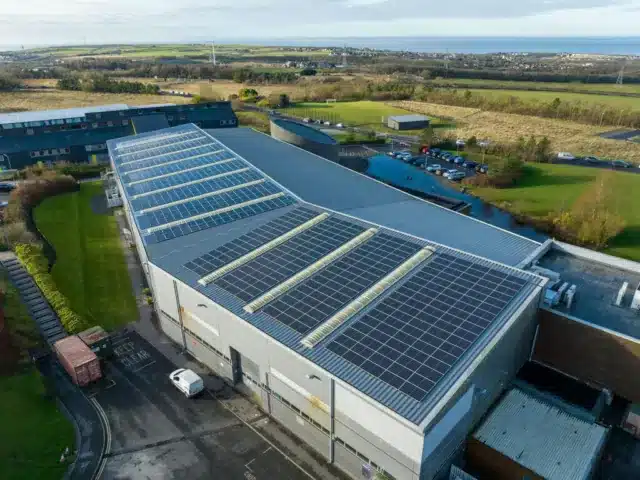
Most industrial buildings in the Rugby area are post-2000 steel-portal-frame structures with profiled metal sheet or standing-seam roofs — the gold-standard substrate for clamp-fix solar PV with zero penetrations. Modern logistics units typically offer 8,000–25,000 sqm of unobstructed roof, supporting 1–5 MW arrays per building.
Industrial Estates in Rugby
Coverage across CV21, CV22 and CV23 plus the Daventry – Lutterworth corridor.
DIRFT Daventry International Rail Freight Terminal
8 miles east. 8M sq ft of warehousing. Tesco, Royal Mail, Eddie Stobart.
Magna Park Lutterworth
12 miles north-east. 6M sq ft. DHL, DSV, Wincanton, M&S.
Glebe Farm Industrial Estate
CV21 1JD. Engineering, light industrial, automotive components.
Central Park Industrial Estate
CV23 0WE. M6 J1 access. Multi-let logistics and manufacturing.
Brownsover Industrial Estate
CV21 1JG. Established manufacturing cluster. Ideal for retrofit PV.
Houlton Strategic Employment Site
CV23 1FB. Newer logistics development — clear-span clamp-fix-ready roofs.
Rugby Factory Solar — By Industry
Sector guides for the dominant Rugby industries.
Distribution & Logistics
DIRFT and Magna Park-style mega-warehouses. 1–5 MW typical, 4–6 year payback on PPA.
Automotive Supply Chain
JLR Tier-1/Tier-2 supplier installs. EcoVadis and CDP-aligned post-commissioning data packs.
Cold Storage
24/7 refrigeration baseload — up to 95% solar self-consumption typical.
Food Production
Ask how the installer will meet your site's BRC v9 audit requirements, including how cables will be routed through hygiene zones.
Plastics & Injection Moulding
High motor and drying loads — strong daytime self-consumption fit.
Print & Packaging
Continuous daytime printing presses pair perfectly with rooftop PV.
Rugby Factory Solar — FAQs
Common questions about industrial solar in Rugby and Warwickshire.
How much does factory solar cost in Rugby?
Industrial solar PV in Rugby typically costs £700–£900 per kWp installed for systems above 100 kW. A 250 kW system on a typical Rugby manufacturing roof costs around £180,000 fully installed. With Annual Investment Allowance (AIA) cover of 100% in year one, the effective cost is reduced by around 25%. Payback typically 3–5 years against current Q1 2026 industrial electricity at 27.69 p/kWh.
Do you handle DIRFT and Magna Park-scale installations?
Yes — multi-MW arrays can be installed on DIRFT and Magna Park-tenant rooftops, including phased installs aligned to lease renewal cycles. See our dedicated DIRFT Northampton solar guide and Magna Park Lutterworth solar guide for tenant-vs-landlord ownership models, PPA structures, and DNO connection availability across the M1/M6 corridor.
What grants are available for Rugby manufacturers?
CWLEP (Coventry & Warwickshire LEP) historically operated low-carbon SME grants — check current Warwickshire County Council and West Midlands Combined Authority programmes. Nationally, the Industrial Energy Transformation Fund (IETF) closed in July 2025 with no successor fund planned, so the Annual Investment Allowance (AIA) — 100% of capex up to £1m in year 1 — is the main relief. When you request quotes, ask each installer to set out which available routes apply to your site.
Which Rugby postcodes do you cover?
This guide covers all of Rugby and surrounding: CV21 (town centre and Brownsover), CV22 (south Rugby and Bilton), CV23 (Houlton, Long Lawford, Cawston, Dunchurch, Newton). It is also relevant to wider Warwickshire and Northamptonshire on the M6/M1/A14 corridor — including Daventry, Lutterworth, Coventry, Northampton, and Leicester.
Will solar work on a 1980s metal-sheet warehouse roof?
Usually yes — a structural survey confirms purlin spacing, fixing condition, and snow/wind loading. Many 1980–90s units in Rugby's older estates need engineer sign-off before install, occasionally combined with a minor refurbishment. Ask the installer to include the structural survey and any roof works in the quote. See our factory roof weight load guide for the full BS 6399 / EN 1991 framework.
Nearby Location Guides
Get Your Rugby Factory Solar Quote
Request matched quotes from commercial solar installers. A quote request carries no obligation.
Request a Free QuoteRugby industrial solar — the local picture
For UK industrial electricity at 27.69 p/kWh (Q1 2026 Ofgem), a Rugby factory drawing 800 MWh/year is paying ~£220,000/year for grid power. A 250 kW rooftop solar PV system on a typical factory roof will offset 35–55% of that, saving ~£58,000 in year 1 with full Annual Investment Allowance tax relief in year 1.
Rugby factory solar by industry
Whatever sector your Rugby factory operates in, the sector guides below cover the specifics.
Rugby factory solar — expanded FAQ
How long does a Rugby factory solar install take?
From contract signature to commissioned system: 8–14 weeks for systems up to 500 kW, 12–16 weeks for 1 MW+. The longest item is the G99 grid connection (6–18 months DNO timeline) which your installer should initiate before contract. Physical install on roof: 2–5 days for 100–500 kW, 5–10 days for 1 MW+. Installers typically schedule the work around your shutdown windows.
What grants are available for Rugby manufacturers?
Nationally: the Industrial Energy Transformation Fund closed in July 2025 with no successor fund planned, so the Annual Investment Allowance (AIA) — 100% of capex up to £1m in year 1 — is the main relief. Locally, ask your local growth hub or combined authority about current regional business support.
Will I need planning permission in Rugby?
In England, rooftop solar PV on non-domestic buildings is usually permitted development (Part 14, Class J of the GPDO) up to 1 MW, subject to conditions; Scotland, Wales and Northern Ireland have their own rules. Listed buildings, conservation areas and PV projecting more than 200mm above the roof need full planning. Your installer should confirm planning status before quoting.
What roof types suit factory solar in Rugby?
All commercial roof types: standing seam metal (clamp-fix, no penetrations), profiled / corrugated metal (rail-mount), flat membrane (ballasted), single-ply EPDM (mechanically fixed). Asbestos-cement roofs cannot be retrofitted — refurbishment to a modern membrane is required first. See our roof weight load guide for structural requirements per roof type.
How do I get a quote for my Rugby site?
Three steps. (1) Submit a quote request with your annual electricity spend and roof type. (2) We pass your enquiry to a matched installer. (3) The installer can then model your half-hourly meter data and roof, survey the site and send a proposal. A quote request carries no obligation.