Data Centres & Colocation

Solar Panels for Data Centres UK

UK data centres consume over 12 TWh annually and growing at 15% per year. With electricity representing 40-60% of operating costs and increasing pressure to demonstrate sustainability, on-site solar generation delivers measurable PUE improvement, cost reduction, and verified Scope 2 emissions cuts.

0.05-0.15
PUE Improvement
15-25%
Cooling Cost Offset
0
Downtime Minutes
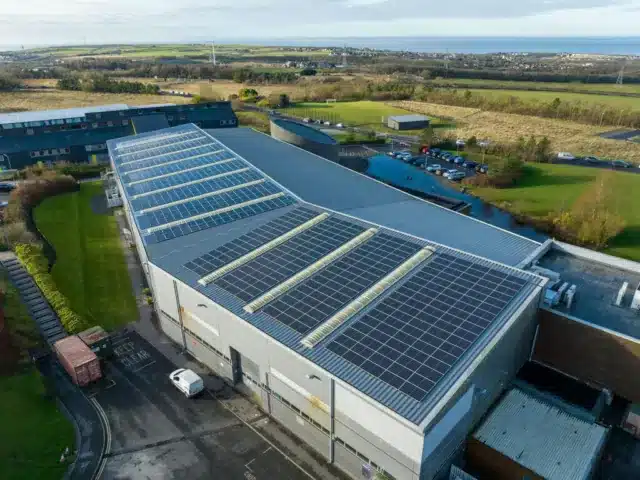
Solar panels installed on data centre facility roof in the UK
99.999% Uptime
Zero disruption guaranteed

Why Data Centres Are Investing in On-Site Solar

Beyond cost savings, data centre operators face mounting pressure from clients, investors, and regulators to demonstrate genuine sustainability progress.

The Data Centre Energy Challenge

Electricity Costs Dominate OpEx

Energy represents 40-60% of data centre operating costs. At 27.69p/kWh (2026 Ofgem non-domestic rate), a 5MW facility spends £8-12M annually on electricity alone. On-site solar provides a fixed-cost energy source immune to wholesale market volatility.

Client Sustainability Demands

Enterprise clients increasingly mandate renewable energy use in vendor selection. On-site solar provides verified, additional generation that satisfies RE100, CDP, and SBTi requirements without reliance on purchased certificates.

Grid Capacity Constraints

New UK data centres face grid connection delays of 3-7 years. On-site solar and battery storage can supplement existing grid capacity, enabling facility expansion without waiting for DNO upgrades.

Regulatory Trajectory

The EU Energy Efficiency Directive already requires data centres to report energy consumption. UK regulations are following. Proactive solar investment demonstrates compliance readiness and sustainability leadership.

Solar-Data Centre Synergies

Peak Cooling Alignment

Solar generation peaks when cooling demands are highest. Summer heat that drives up CRAC/CRAH energy consumption coincides with maximum solar output, providing natural load matching.

Constant Base Load = Maximum Self-Consumption

Data centres never stop consuming electricity. Every kWh of solar generated is consumed immediately on-site, achieving 95%+ self-consumption ratios.

Energy Price Hedging

On-site solar locks in a portion of energy costs at £0.03-0.04/kWh LCOE for 25+ years, providing a natural hedge against volatile wholesale electricity prices that have swung 200-300% in recent years.

Battery Storage for Grid Services Revenue

Co-located battery storage paired with solar enables participation in frequency response, capacity market, and demand turn-up services, generating additional revenue streams of £50-100/kW/year.

Data Centre Solar ROI Analysis

Financial modelling for UK data centre solar installations at 2026 energy prices

Facility Type IT Load Solar System Investment Annual Saving Payback
Edge / Small Colo 500kW 250kW rooftop £162,000 £52,000 3.1 years
Medium Colocation 2MW 750kW rooftop £435,000 £148,000 2.9 years
Large Enterprise 5MW 1.5MW roof + ground £870,000 £296,000 2.9 years
Hyperscale Campus 20MW+ 5MW+ ground mount £2.5M+ £850,000+ 2.9 years

Based on 27.69p/kWh Ofgem non-domestic rate (Q1 2026), 950 kWh/kWp yield, 95%+ self-consumption. Excludes additional revenue from grid services.

Zero-Downtime Installation Process

Engineered for facilities where every minute of uptime matters

1

Facility Assessment

Full site survey including roof structure, electrical infrastructure, grid connection capacity, and cooling system integration points. Detailed method statement provided.

2

Design & DNO Application

System designed around your power architecture. G99/G100 application submitted. Redundant connection pathways engineered to maintain Tier III/IV compliance.

3

Non-Disruptive Install

Ballasted roof mounting with no penetrations. Pre-assembled components minimise on-roof time. All hot works excluded near critical infrastructure.

4

Commission & Monitor

Phased commissioning with real-time monitoring integration. DCIM connectivity for power and generation tracking alongside existing infrastructure metrics.

Frequently Asked Questions

Common questions about solar for data centre facilities

How do solar panels improve data centre PUE?
Solar panels directly reduce the grid energy component of Power Usage Effectiveness (PUE). By generating on-site renewable electricity that offsets cooling and ancillary loads, a data centre's effective PUE can improve by 0.05-0.15 points. For a 5MW facility, this improvement translates to hundreds of thousands of pounds in annual savings while demonstrating measurable sustainability progress to clients and investors.
Can solar panels be installed on a data centre without any downtime?
Yes, our data centre installations achieve zero downtime. All roof-mounted work is completed without penetrating the building envelope. Electrical connections to the main switchgear are designed with redundant pathways and hot-swap capabilities. Grid connection remains active throughout commissioning. We work within your maintenance windows for final switchgear integration, and provide detailed method statements reviewed by your operations team before any work begins.
What size solar system does a typical UK data centre need?
System sizing depends on available roof and ground space, IT load, and sustainability targets. A small edge facility (500kW IT load) might install 200-400kW of solar. A medium colocation centre (2-5MW) could deploy 500kW-1.5MW. Large hyperscale campuses with available land can install 2-10MW+ including ground-mounted arrays. Solar typically covers 10-25% of a data centre's total load, with the remainder sourced through corporate PPAs and grid supply.
Do data centre solar installations qualify for Enhanced Capital Allowances?
Yes, data centre solar installations qualify for Enhanced Capital Allowances (ECA) providing 100% first-year tax deduction on qualifying equipment. For a 1MW installation costing approximately £580,000, this can reduce your corporation tax liability by over £140,000 in year one. Battery storage systems added alongside solar also qualify, making the combined investment highly tax-efficient.
How does on-site solar help meet RE100 and net zero commitments?
On-site solar generation provides verified, additional renewable energy that directly counts toward RE100 commitments and Scope 2 emissions reduction. Unlike purchased REGOs (Renewable Energy Guarantees of Origin), on-site generation is universally accepted by all sustainability frameworks including CDP, SBTi, GRI, and TCFD. It also provides price certainty against volatile wholesale electricity markets, supporting long-term net zero planning.

Get Your Free Data Centre Solar Assessment

Our data centre energy team will analyse your power architecture, cooling loads, and available space to design a solar solution that improves PUE and reduces OpEx.

Confidential assessment. NDA available on request. Detailed financial model included.

Related Resources