Cold Storage & Refrigerated Logistics

Solar Panels for Cold Storage Warehouses UK

Cold storage facilities consume 3-5x more electricity per square metre than standard warehouses. With compressors running 24/7 and peak demand during summer months perfectly aligned with solar generation, refrigerated warehouses achieve some of the fastest ROI in the industry.

55%
Energy Cost Reduction
3.2yr
Average Payback
0%
Cold Chain Disruption
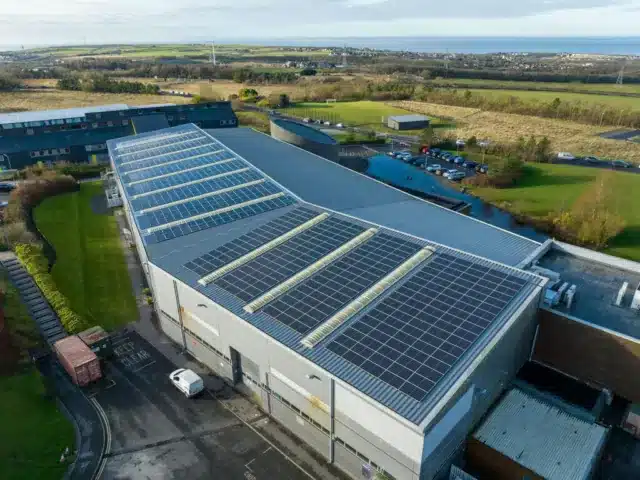
Solar panels installed on cold storage warehouse roof in the UK
24/7 Operations
Zero cold chain interruption

Why Cold Storage Facilities Are Ideal for Solar

Refrigerated warehouses have the highest energy consumption per square metre of any commercial building type, making them prime candidates for solar investment.

Cold Storage Energy Profile

Compressor Systems 55-65%

Continuous refrigeration cycle - the largest single energy consumer running 24/7/365

Condenser Fans & Evaporators 15-20%

Air circulation and heat rejection - peaks during warm weather aligned with solar output

Lighting & Dock Operations 10-15%

LED warehouse lighting, dock levellers, forklift charging, office systems

Defrost Cycles 5-10%

Electric or hot gas defrost operations for evaporator coils

Typical Energy Consumption

Frozen Storage (-25°C)
180-250 kWh/m²/year
Chilled Storage (2-5°C)
80-130 kWh/m²/year
Mixed Temperature
120-180 kWh/m²/year
Standard Warehouse
30-50 kWh/m²/year

The Solar-Cold Storage Advantage

Peak Demand Alignment

Summer heatwaves drive both peak solar generation and peak refrigeration demand. When your compressors work hardest, your solar system generates the most electricity.

Massive Base Load = High Self-Consumption

Unlike intermittent users, cold stores consume electricity continuously. Every kWh generated is used immediately, maximising the value of each solar panel installed.

Large Flat Roof Area

Cold storage warehouses typically have expansive flat roofs with minimal obstructions, providing maximum usable area for solar panel installation.

Energy Security for Critical Operations

Paired with battery storage, solar provides backup power for critical refrigeration, protecting millions of pounds of perishable stock during grid outages.

Scope 2 Emissions Reduction

Major retailers increasingly require cold chain suppliers to demonstrate carbon reduction. Solar provides verified, measurable Scope 2 reductions for ESG reporting.

Solar Solutions by Cold Storage Type

Tailored solar system designs for every type of temperature-controlled facility

Frozen Storage (-18°C to -25°C)

The highest energy consumers in the cold chain. Typical system: 400-800kW. Annual savings: £90,000-£160,000. Payback: 2.8-3.5 years.

  • Ammonia & CO2 compressor offsetting
  • Battery backup for critical freezing
  • Peak shaving for demand charges

Chilled Distribution (2-5°C)

High-throughput facilities with constant door openings. Typical system: 250-500kW. Annual savings: £55,000-£95,000. Payback: 3-4 years.

  • Multi-zone temperature management
  • Dock door energy loss mitigation
  • EV fleet charging integration

Pharmaceutical Cold Chain

GDP-compliant storage requiring precise temperature control. Typical system: 200-400kW. Annual savings: £45,000-£80,000. Payback: 3.5-4.5 years.

  • GDP & GMP compliance maintained
  • UPS integration for critical loads
  • Temperature monitoring continuity

Cold Storage Solar ROI Breakdown

Real-world cost and savings data for UK cold storage facilities at 2026 electricity rates

Facility Type Roof Area System Size Installed Cost Annual Saving Payback
Small Cold Store 2,000m² 150kW £105,000 £32,000 3.3 years
Medium Refrigerated Warehouse 8,000m² 400kW £260,000 £82,000 3.2 years
Large Frozen Distribution Centre 20,000m² 1MW £580,000 £195,000 3.0 years
Multi-Temperature DC + Battery 15,000m² 750kW + 500kWh £620,000 £155,000 4.0 years

Based on 27.69p/kWh Ofgem non-domestic rate (Q1 2026), 950 kWh/kWp annual yield, and 85% self-consumption ratio typical for cold storage.

Cold Storage Solar Installation Process

Designed around 24/7 cold chain operations with zero disruption to temperature-controlled environments

1

Cold Chain Energy Audit

Half-hour interval data analysis of compressor loads, defrost cycles, dock operations, and seasonal demand patterns.

2

Roof & Structural Survey

Assessment of insulated roof panels, load capacity, membrane integrity, and optimal non-penetrative mounting approach.

3

Non-Disruptive Installation

Ballasted mounting preserves roof insulation envelope. Electrical works scheduled around operational requirements.

4

Commission & Optimise

System commissioned with real-time monitoring. Energy management optimised for your specific compressor scheduling.

Frequently Asked Questions

Common questions about solar panels for cold storage facilities

How much can cold storage facilities save with solar panels?
Cold storage facilities typically save 45-55% on electricity costs with a correctly sized solar installation. A 500kW system on a large refrigerated warehouse saves £80,000-£120,000 annually at 2026 electricity rates. The high base load from compressors running 24/7 means solar generation during daylight hours directly offsets significant consumption, with payback periods of 3-4 years.
Do solar panels work effectively on insulated cold storage roofs?
Yes, insulated cold storage roofs are excellent for solar installations. The thick insulation panels (typically 100-200mm PIR) provide a stable mounting surface. Non-penetrative ballasted mounting systems like K2 D-Dome are used to maintain the roof's thermal envelope integrity. The insulation actually benefits solar panel efficiency by preventing heat transfer from the building below.
Can solar panels offset the energy used by blast freezers?
Solar panels significantly reduce the overall electricity cost of blast freezing operations. While blast freezers have high instantaneous power demands, the compressors that maintain storage temperatures run continuously and represent 60-70% of total energy use. Solar directly offsets this base load during daylight hours. Combined with battery storage, facilities can achieve 70-80% self-consumption and reduce peak demand charges by 30-50%.
What size solar system does a cold storage warehouse need?
System sizing depends on warehouse size, temperature requirements, and throughput. Small cold stores (under 5,000m²) typically need 100-250kW. Medium facilities (5,000-15,000m²) require 250-500kW. Large distribution centres with multiple temperature zones benefit from 500kW-1.5MW installations. A detailed energy audit of your compressor loads, defrost cycles, and dock door operations determines the optimal configuration.
Will solar installation disrupt cold chain operations?
Our cold storage installations are designed for zero cold chain disruption. All roof work uses non-penetrative mounting systems that do not breach the insulated envelope. Electrical connections are made during planned maintenance windows. Temporary power provisions maintain compressor operation throughout commissioning. We provide a detailed installation programme that accounts for your delivery schedules and operational requirements.
Is battery storage worth adding to a cold storage solar system?
Battery storage is particularly valuable for cold storage facilities. It enables peak shaving to reduce maximum demand charges (often 30-40% of the electricity bill), provides backup power for critical refrigeration during grid outages, stores excess daytime solar for overnight compressor loads, and enables participation in grid balancing services for additional revenue. ROI on battery storage for cold stores is typically 5-7 years, with combined solar-plus-storage systems achieving overall payback of 4-5 years.

Get Your Free Cold Storage Solar Assessment

Our cold chain energy specialists will analyse your compressor loads, roof configuration, and operational patterns to design the optimal solar system for your facility.

Free site survey within 5 working days. No obligation. Detailed ROI analysis included.

Related Resources

Cold Storage Solar Service Areas